> For the complete documentation index, see [llms.txt](https://docs.dataimpulse.com/llms.txt). Markdown versions of documentation pages are available by appending `.md` to page URLs; this page is available as [Markdown](https://docs.dataimpulse.com/dashboard/2fa.md).
# 2FA
Two-factor authentication on your DataImpulse account. Step-by-step guide to securing your proxy dashboard with 2FA for enhanced account safety.
#### Two-Factor Authentication (2FA)
Two-factor authentication (2FA) is mandatory for all user accounts as an additional security control to reduce the risk of unauthorized access. It is enabled by default using email-based verification and cannot be disabled.
**Configuration and Supported Methods**
Two-factor authentication can be configured on your DataImpulse dashboard in the profile [security settings](https://app.dataimpulse.com/account/security).
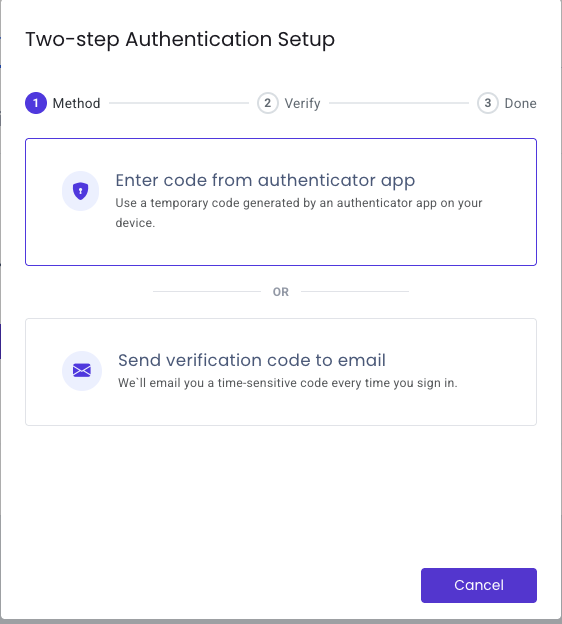
The following authentication methods are supported:
* Authenticator application (a temporarily generated code)
* Email-based verification - enabled by default
You can switch your 2FA method between email and an authenticator app at any time, but 2FA itself cannot be turned off - one of the two methods always stays active.
{% hint style="info" %}
Please note: **2FA applies only to standard email/password login**. It does **not** apply when signing in via **Google or LinkedIn**.
{% endhint %}
{% embed url="" %}
---
# Agent Instructions
This documentation is published with GitBook. GitBook is the documentation platform designed so that both humans and AI agents can read, navigate, and reason over technical content effectively. Learn more at gitbook.com.
## Querying This Documentation
If you need additional information that is not directly available in this page, you can query the documentation dynamically by asking a question.
Perform an HTTP GET request on the current page URL with the `ask` query parameter, and the optional `goal` query parameter:
```
GET https://docs.dataimpulse.com/dashboard/2fa.md?ask=&goal=
```
`ask` is the immediate question: it should be specific, self-contained, and written in natural language.
`goal` is optional and describes the broader end goal you are ultimately trying to accomplish on behalf of the user. GitBook uses it to tailor the answer towards what is most useful for that goal.
The response will contain a direct answer to the question and relevant excerpts and sources from the documentation.
Use this mechanism when the answer is not explicitly present in the current page, you need clarification or additional context, or you want to retrieve related documentation sections.